I worked from home (WFH) long before work from home was cool — or even possible — in many jobs.
In the mid-90s, I worked for a large trade association, handling its government affairs activities in my part of the country. They gave us a laptop and a travel budget and told us to be productive.
But no office. My office was my couch, my floor or wherever I could sit in my 600 sq. ft studio apartment that allowed my phone cord to connect with my computer for internet service (and with that, I’ve turned into a relic to 20-somethings who think I’m talking about the Prehistoric Age) and just hope that the bleating “internet is connecting” sound meant I’d be able to send an email. It was liberating, as I knew that many of my other friends were sitting in offices, chained to their desks all day. But it had its challenges.
I’d climb the walls, feel like it had been weeks since I had seen another human being (even if it had been hours), and I’d feel like I needed a change of pace.
Fast forward 20 years, and we’re now in an era of incredible technology, wireless everything, remote work being encouraged both out of capability and necessity, but I’m hearing some companies once again moving to a new era of chaining people to their workspaces.
Some are telling employees that they must — not may — work from home. And that the laptops they’ve had will be phased out and replaced with desktops.
If you’re in a company, even if you’re thinking about this, take a deep breath and consider how it would be rolled out. It’s the point when work from home can go really well and feel like a benefit or it feels like solitary confinement.
Employees who loved the worktop and could switch from the backyard to the kitchen to a home office are now being told they need to pick where they’ll sit every day because… desktop.
Employers, I’m telling you, don’t FORCE your employees to be tethered to one place in their homes to work if you can help it. I’m partly talking about the design of workspaces, but mainly about culture, workplace retention, and quality-of-life issues.
WFH is great for its flexibility, but it can be just as isolating if employers don’t address it purposefully and thoughtfully.
You get stir crazy.
Work time and off hours become intermingled and hard to define.
Home doesn’t feel as homey.
And the one spot in the world that’s supposed to be your safe place no longer feels as welcoming.
I am typing this blog on my laptop in a large open area of the local church I attend because the walls of my office close in on me regularly. Every so often, it doesn’t feel like a place I want to go work. It feels like a place that confines me.
And when that happens, it confines my ability to be creative, positive, and productive. As a result, I leave the house and find somewhere that doesn’t feel assigned to me.
I believe one of the challenges of new work-from-home jobs is when employees feel this arrangement is forced on them and then micromanaged. It’s at that point when your boss is running your home. And at some point, employees will push back, leave, or mentally check out.
The example I mentioned of imposing desktops on employees is a great way to accelerate the decline in job satisfaction. I understand some security concerns may be addressed by having a fixed computer location, but that’s not the case in many jobs. If you can avoid the problem, do so.
If a company can do it, let people figure out how they want to work from home — and not force them into a room that becomes their only, permanent workspace.
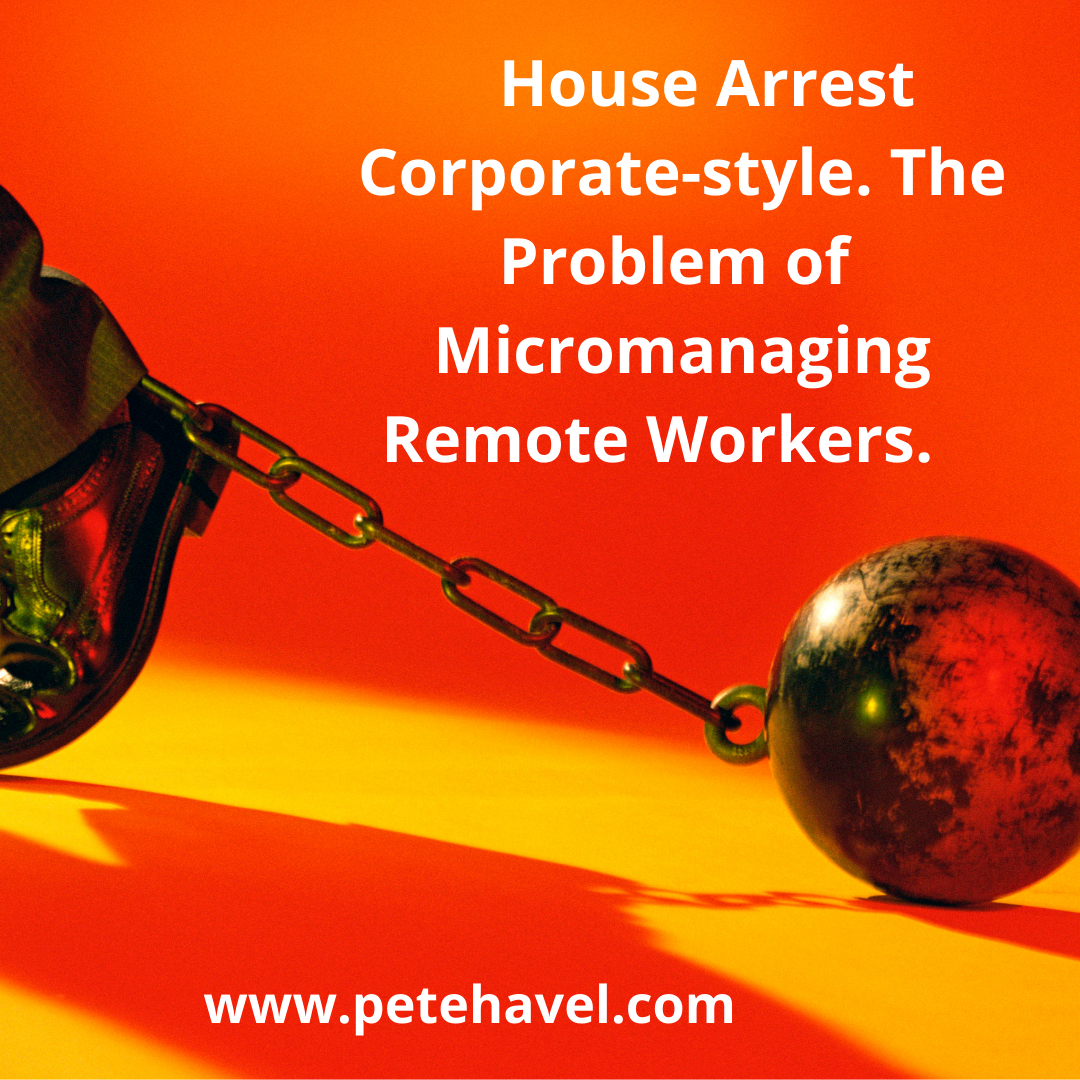
Because that feeling can start to feel a lot like house arrest. And that “prisoner” chained to the desktop may want to escape their job.
If you don’t give them the flexibility to work where they want to, someone else will. And that ball and chain? It’s what will slow your company’s success down for years to come.
Pete Havel is a speaker, trainer, and consultant on workplace culture and leadership. He speaks and consults for organizations ranging from law enforcement agencies to Fortune 500 companies. He’s also the author of “The Arsonist in the Office: Fireproofing Your Life Against Toxic Coworkers, Bosses, Employees, and Cultures,” which was named a #1 Hot New Release by Amazon. It’s available at www.arsonistintheoffice.com
Pete can be reached at pete@petehavel.com.